Showing posts with label greek style. Show all posts

Jul 23, 2012

Hermes: The Summer Campaign is Shot on Aegina Island, Greece

The beauty of the pictures speaks for itself. The purity of line, the wisdom of time, the sparsity of luxury. All these are represented perfectly by the French sellier -which became the fashion and leathergoods luxe house- and the eternal Greek ideal. The mighty, sturdy olive, gigantic through the passage of the centuries, the clear skies, the flowing fabrics, the architectural lines, the "nothing in excess" spirit.

The campaign's motto? "Le Temps Devant Soi"...time before you.

Enjoy!


Mar 24, 2012

Greek Black: Powerful Symbol, Impeccable Style

"When I finished primary school in Distomo I had to go to the Gymnasium in Livadeia. At the time, traveling by bus from Distomo to Livadeia was too long and lasted three hours. When my father and I got off the bus in the morning, I saw 10 girls in colorful skirts. I asked him: '' Why do the girls wear such colors, father?" I had hitherto never seen a woman or a girl NOT wearing black in Distomo, because of the Holocaust in 1944" recalls Thanasis Panourgias, Distomo's mayor today, then only a young child.

The testimony reflects the nightmare of the Holocaust June 10, 1944 in Distomo, where 223 people -including elders, women and children- were massacred by the fourth Constitution of Police SS in retaliation for the losses the Germans had by partisans of the 3rd Constitution of the 34th battalion of ELAS (National Lberation Front).


old lady in Crete


Black was (and still is) synonymous with mourning in Greece. For a very long time, there was always someone in the family mourning for the loss of other members; be it from famine, or war, or hostile acts related losses (the Civil War, the Turkish invasion of Cyprus) ; or some of these combined. The longest time of continuous peace in Greece has been a mere 48 years (since 1974). This is why there are so many little old ladies clad in black attire, all wrinkled up in folklore pictures circulating all over the net; they still mourn family members lost in Nazi atrocities  most  likely.

Manos Katrakis

The tradition in villages was that if you lost your parents it was customary to wear black for at least 40 days (though many opted for a lot longer); if you lost a spouse, habitually for 7 years (or as long as you considered yourself a widow after that); and if you lost a child....you never got out of black, you wore it for life....

papa-Noufrakis (the priest head of Orthodox Mass at the St.Sophia in 1919 in Istanbul)

Black is also the colour of choice for the clergy. From head to toe. Solemn and in accordance to the suffering of the grieving parish. Every parish had their own grievers, you see. 

Cretan attire

Mourning sometimes gets to an almost nationalistic level. The classic Cretan attire is consisting of black shirt (morning for the losses in the Cretan war against the Turks), beige or midnight blue jodhpurs ("vraka", a classic rider's pair of pants), black boots and a black crocheted handrkerchief tied on the forehead (the "sariki"). The tassels on the latter are representing tears for the Greek holocaust at Arcadi monastery.
[I have to say, despite myself, I find the effect very virile-looking.]

Black looks exceptionally good under the intense sun, against the white houses and the blue sea (as does white) or the grey of the rock. This is probably why it ended up defining Greek style. All the other colours gain an added intensity under the sun, sometimes to the point of blinding. You just can't go wrong with black.

Elli Lambeti in A Girl in Black (1956)
dance performance En Attendant
dress by Elena Troulakis
Dress by Elena Troulakis

photos via costumes.gr, kairatos.com.gr,greekfilmfestival.com.au, 2rizospastis.gr, ethnos.gr, infokids.gr

Sep 6, 2011

The Wedding Procession


Photo copyrighted by Elena Vosnaki, shot on the island of Sifnos, Greece, summer 2011. Click to enlarge.

Sep 1, 2011

Greek Beauty: Ros Georgiou

Ros Georgiou shot by Thanassis Krikis for Vogue Hellas.

17-year-old Rosanna "Ros" Georgiou is a model of Greek/Dutch origin, but I think it is her Greek DNA which brings out a certain "pride" attitude on her face, making her an exceptional canvas for classicism.
At the same time she possesses a defiant stance on proceedings, maybe due to her newess in the field or coming out of left-field (living in Athens, rather than one of three predictable fashion metropolises) which makes her totally modern.


ROS GEORGIOU by HARIS FARSARAKIS from haris farsarakis photography on Vimeo.

Jul 16, 2011

Humble Herbs, Rustic Roots


There is something about the herbs of Greece: They're sprouting with the insolence of the race, haphazardly and defiantly, surely against all odds. They're fragrant with a rustic honesty that is superior to artificial pretence. And they stand best when they stand proud on a most formal of setting: a wedding procession.

Shot on the island of Sifnos, Greece, summer 2011. Click to enlarge.
Photo copyrighted by Elena Vosnaki

Jul 14, 2011

Colour me In


The sparkling background of the white-washed church brings out the pastel hues of this wedding guest's outfit. Greek women shouldn't be afraid of colour. Or fresh fragrant flowers in the hair.


Shot on Sifnos island, summer 2011. Click to enlarge.

Photos copyrighted by Elena Vosnaki.

Jul 8, 2011

The Continuity of Greek Elegance


fresco from the palace of Knossos, Crete, Greece, at the Heraklion Archaeological Museum, 
15th century BC


mature Greek woman attending a wedding on the island of Sifnos, Greece, summer 2011

Apr 20, 2011

Greek Easter: A Celebration of Spring Awakenings

It's no hyperbole to say there is no celebration more joyful, more optimistic, more heart-wrenching, in its way, in all of the Greek calendar (and it is already full of those) than Orthodox Easter. The awakening of spring, which sheds its pagan archetypes shining upon everything is walking hand in hand with the tradition of a pious Christianity that is nevertheless smiling, instead of morose, and lenient, instead of boasting a stern Biblical face.


In the processions of the Holy Week, especially in the sunny, picturesque countryside and on the numerous islands, I can still witness the joie de vivre that can exist only in cultures that have been deprived for long; it is only then that people can appreciate the smalleest pleasures, the generosity of nature itself, the simple human contact that needs no social agenda whatsoever. Man is enjoying life, much like he did in the classical era, because he's not entirely convinced there will be a better one, even though the prospect of one delights his soul through the promise of spring's and Christ's resurgence. In Greece where the National Revolution also symbolically sprang along with the first throes of spring, resurgence takes on a loaded nuance: the soul fills with renewed courage for every hardship ahead.

The spring air is aromatized with fragrant effluvia from trees and plants, an intoxicating bouquet that is hard to forget: bigaradiers with orange blossoms in full bloom, bushes of lilacs (called Πασχαλιά/Pashalia in Greek because they bloom exactly during the month of April, when Pasha is celebrated), violets in deep shades but also stocks (Mathiola longipetala) with their spicy, skatole-rich, intense aroma. Dill, thyme, spearmint and humble chamomille are beginning to make the countryside smell like a giant pasture or one enormous kitchen herbs cabinet.
And of course food, glorious food: from red Easter eggs, which make households smell of vinegar and onion peel (traditionally used to "anchor" the dye on the hand-painted egg) as they're prepared on the eve of Good Friday, to the succulent, sweet, cardamom-laced Eastern bread which whets the appetite for the feast of Sunday.

Greek Easter is a Dionysian celebration...

Mar 14, 2011

Greek Goddesses: 2.Elli Lambeti


Probably the most sensuous and sensitive actress of the Greek cinema & stage: Her gaze was a sigh.


Clip from the film The Counterfeit Coin, 1955, by Yorgos Javellas. Elli Lambeti says "I love you" to Dimitris Horn.


Clip from the film Woman in Black, 1956, by Michalis Kakoyiannis.

Feb 11, 2011

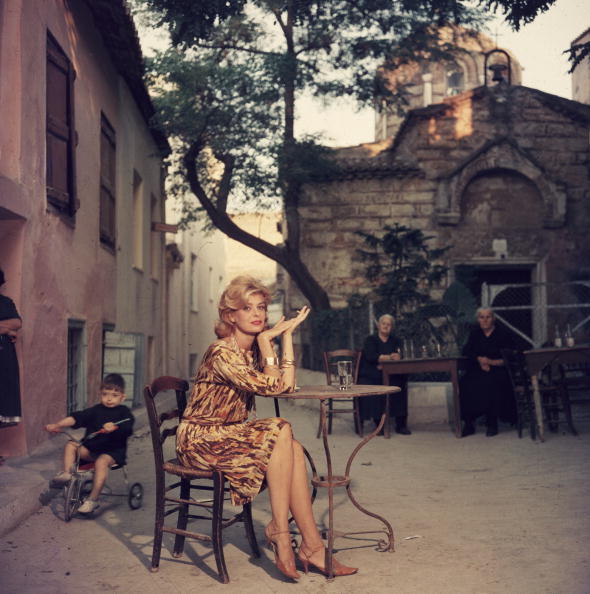
Greek Goddesses: 1.Melina Merkouri


Personality personified. Everything she did, she did with passion, a distinctly Greek trait. Even when misguided, petty things slided off her like water slides off a swan's feathers. Her grace and natural elegance were juxtaposed to a certain je m'en fous attitude and her adherence to who she was.


To the manor born and a prominent actress of international fame, when she was participating in the socialist governemnt of A.Papandreou during the 1980s she was advised to tone down her appearence when going to give a talk in poorer districts of Athens. Melina, defiant and true to herself, refused to get out of the YSL saying "this is who I am, I would be an imposter to don a chinz to go and pretend I'm something I'm not".


Loved and despised like few people have been, she never let anyone indifferent. Isn't that the very essence of being interesting?


The Greeks will be eternally grateful to her for championing the cause of the Elgin Marbles; the missing parts of the sculptures of the Parthenon up on the Acropolis, which were smuggled off the country during the Turkish occupation and the upheaval of the National Revolution by Lord Elgin and were deposited in the British Museum where they remain to this day.


"I flirted down to the last minute of my life", she's quoted to say. The cigarette that was perennially hanging off her lips cut the thread of her life. It was well spent. Opa!